
Australia Puts Data Centres on the Hook for Their Own Power
Australia’s booming data centre industry is colliding with a simple constraint: electricity infrastructure cannot expand at digital speed without someone paying for
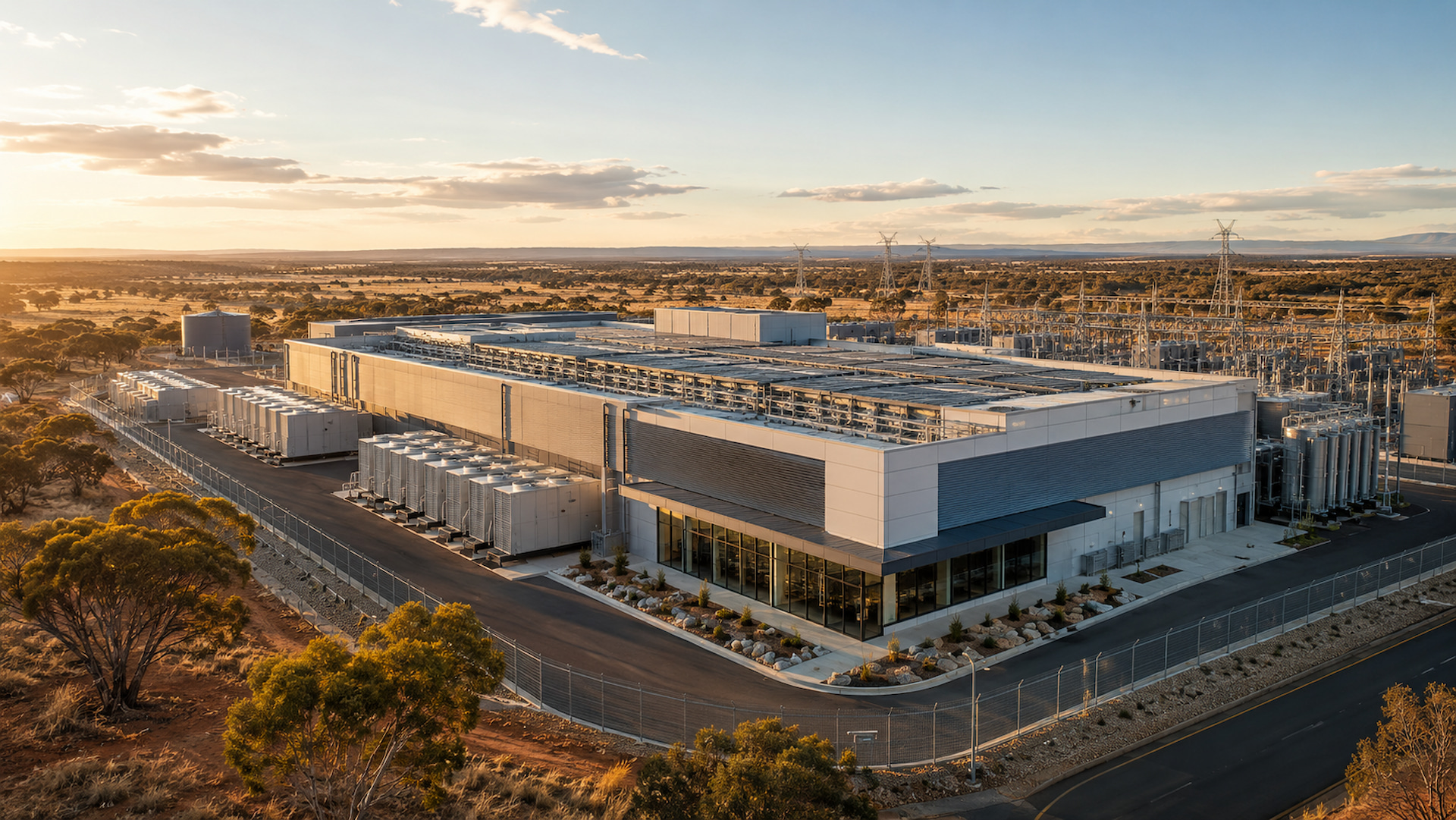
Australia’s booming data centre industry is colliding with a simple constraint: electricity infrastructure cannot expand at digital speed without someone paying for it.
Over the past week, Australian policymakers have begun answering who that someone should be. A series of measures at federal and state level is taking shape around a common principle. Large data centres will be expected not merely to consume clean electricity, but to help finance new generation, support the grid when supply is tight and cover the infrastructure costs created by their enormous loads.
For battery storage developers, the consequences could be significant. Batteries are emerging not as an optional addition to renewable procurement, but as one of the most practical ways for data centre operators to satisfy the proposed rules.
The regulatory push accelerated across three fronts. The Australian Energy Market Commission, or AEMC, published a four-part framework for renewable electricity obligations. New South Wales moved to establish grid-access rules for large electricity users modelled on its Renewable Energy Zones. At the same time, federal Energy Minister Chris Bowen made clear that states opposing the national approach would not be permitted to establish weaker requirements.
Together, the measures are beginning to define the electricity conditions under which Australia’s next generation of data centres will operate.
From electricity consumer to energy participant
The policy direction was established on 15 July, when Prime Minister Anthony Albanese announced that large data centres would face a legal obligation to become net generators of renewable energy.
The concept goes considerably further than purchasing renewable electricity certificates. Operators would be required to support new electricity supply, bear the appropriate cost of connecting their facilities and reduce consumption when grid conditions demand it.
The scale of the issue explains the urgency.
The federal government estimates Australia’s prospective data centre investment pipeline at AU$150 billion, equivalent to roughly US$99 billion. The Australian Energy Market Operator, AEMO, expects electricity consumed by data centres could eventually account for 10% of total National Electricity Market demand by 2050. Today, their share is approximately 2%.
That trajectory turns data centres from a relatively specialised industrial load into a major electricity-system planning issue.
The AEMC submitted its recommendations to the Energy and Climate Change Ministerial Council on 28 July before publishing them on 5 August. Its framework addresses four interconnected problems: renewable additionality, firm electricity supply, market visibility and demand flexibility.
The first proposal targets a familiar weakness in renewable procurement.
Data centres would have to offset their electricity consumption using certificates associated with new renewable generation under the existing Renewable Electricity Guarantee of Origin, or REGO, system. This additionality requirement is important because simply purchasing certificates from an established wind or solar project does not necessarily cause another megawatt of renewable capacity to be built.
Under the proposed framework, growing electricity demand would therefore need to be accompanied by additional supply.
The second recommendation tackles a different problem. Renewable certificates account for clean generation, but they do not ensure electricity will be available at the precise moment a data centre needs it.
Data centres would consequently need to contract for firming capacity alongside their renewable certificates.
That requirement is where battery energy storage systems become particularly relevant.
A third recommendation would require sufficiently large data centres to register as participants in the National Electricity Market. Registration would provide AEMO with real-time visibility over major inverter-based loads while creating the regulatory mechanism necessary to enforce firming requirements.
The final recommendation encourages flexible electricity demand and facilitates the co-location of generation and storage through grid connection agreements.
Taken together, the four measures amount to a substantial change in the relationship between data centres and the electricity system. Procuring renewable attributes would no longer be enough. Operators would increasingly have to demonstrate how their demand is physically supported.
New South Wales redraws the connection rules
While the AEMC was outlining the national architecture, New South Wales was addressing another contentious question: who should pay when a massive new electricity consumer requires additional network infrastructure?
The state introduced its Electricity Infrastructure Investment Amendment Bill 2026 on 5 August. The legislation extends a regulatory model already used for Renewable Energy Zones to large-load infrastructure.
Under the proposed system, the NSW energy minister could declare access schemes covering all or part of the state. Those schemes could authorise or restrict access to designated network infrastructure for facilities capable of transmitting at least 5MW.
Renewable Energy Zones already use controlled access to coordinate large concentrations of generation. Rather than allowing projects to connect independently without regard to collective network constraints, authorities can determine which projects receive access, establish charges and allocate infrastructure costs among participants.
NSW has employed the approach in renewable development areas including Central-West Orana and New England. The new legislation would adapt that logic to major electricity consumers such as data centres.
Its most consequential provisions concern cost allocation.
When setting access charges, the consumer trustee would have to ensure that data centres pay for the network infrastructure necessitated by their electricity demand. Ordinary NSW electricity customers would not be expected to subsidise those costs.
The legislation goes further by expressly preventing the consumer trustee from maximising financial returns for electricity consumers when establishing fees under large-load infrastructure access schemes. The objective is instead to allocate costs to the projects creating the requirement for additional infrastructure.
The definition of a network operator would also be expanded to cover parties engaged in planning, financing, developing or constructing network assets. That could provide greater flexibility in structuring the infrastructure needed to connect unusually large loads.
Canberra draws a national floor
Not every jurisdiction agrees with the emerging framework.
Queensland and the Northern Territory opposed the nationally consistent approach during the 28 July meeting of the Energy and Climate Change Ministerial Council, breaking with the six other state and territory governments.
Their concerns focused on both the timing and design of the obligations. Queensland, in particular, indicated that it was not yet prepared to support federally mandated renewable requirements at the current stage of market development.
The federal government’s response has been unequivocal.
Speaking at the National Press Club on 5 August, Bowen said jurisdictions could impose stronger conditions but would not be able to weaken the national baseline.
Canberra intends to use its authority over AEMO and the AEMC to ensure new data centres receive grid connections only under conditions consistent with the national framework, including in jurisdictions that decline to formally support the agreement.
States would retain considerable discretion above that threshold. They could demand larger renewable contributions, stricter additionality provisions or other stronger conditions.
What they could not do is compete for data centre investment by offering materially weaker electricity obligations.
That distinction is central to the federal strategy. Without a common minimum standard, jurisdictions eager to attract billions of dollars in digital infrastructure investment could face incentives to relax energy requirements.
National Cabinet is expected to consider the framework in August 2026. Federal legislation giving the policy full legal force is anticipated in early 2027.
Why batteries suddenly matter more
The firming requirement could become one of the most commercially important parts of the framework.
A data centre might purchase enough renewable certificates to account for its annual electricity consumption and still face a fundamental operational problem. Solar and wind output fluctuate, while data centres generally require continuous, highly reliable electricity.
Firming bridges that gap.
Battery storage installed alongside renewable generation can absorb electricity when production exceeds immediate demand and discharge it when generation falls. For data centre operators, that capability turns variable renewable output into a more controllable electricity resource.
It can also provide advantages beyond regulatory compliance.
Battery storage integrator Fluence has identified three problems that co-located storage can address for data centres: smoothing electricity demand, providing cold-start backup capability and accelerating access to power.
The final point may prove particularly valuable in markets where grid connections have become a bottleneck.
Fluence’s analysis of the US market found that combining a data centre with battery storage, thereby reducing the amount of firm capacity required from the grid operator, could shorten an interconnection process from approximately three years to 15 months.
For facilities whose commercial value depends on becoming operational quickly, shaving more than a year from an electricity connection timetable can materially alter project economics.
The AEMC’s fourth recommendation creates a regulatory route for comparable configurations in Australia by explicitly supporting co-located generation and storage within connection agreements.
A potentially enormous new storage market
The numbers already sitting in Australia’s connection queue illustrate the scale of what could follow.
AEMO has identified 17 data centre load projects progressing through the transmission connection process with a combined maximum capacity of 9GW.
More than half of that capacity, 52%, is located in New South Wales. Victoria accounts for another 31%, while South Australia represents the remaining 17%.
Not every gigawatt of data centre demand will require an equivalent amount of battery capacity. Nevertheless, even partial adoption of co-located storage across those projects could produce substantial additional demand for battery energy storage systems.
If firming becomes a mandatory component of compliance, storage procurement associated with data centres could begin competing in scale with parts of Australia’s existing utility battery development pipeline.
That would also change the commercial relationship between digital infrastructure companies and renewable energy developers.
Singapore-headquartered AirTrunk, which operates 11 data centre facilities across the Asia-Pacific region, has argued that large data centres can function as anchor customers for new clean energy infrastructure. Their long-term electricity requirements can provide developers with the demand certainty needed to finance generation and storage before those assets would otherwise have been built.
Under the emerging Australian rules, that relationship could move from corporate preference toward regulatory necessity.
Long-duration contracts between data centres and electricity projects would consequently become more than instruments for meeting voluntary sustainability targets. They could form part of the compliance architecture supporting project finance, power purchase agreements and new generation investment.
The timetable now moves from policy to implementation
The three regulatory tracks will not take effect simultaneously.
The AEMC estimates that the renewable certificate obligation could be implemented within approximately 12 months of ministerial endorsement. Market registration requirements and connection reforms are expected to require between 24 and 36 months.
Proposed changes to the National Electricity Rules are scheduled for consideration by the Energy and Climate Change Ministerial Council in September 2026.
New South Wales, meanwhile, has already introduced its legislation, although further detail will be required before the design of individual large-load access schemes becomes clear.
What has changed is the direction of travel. Australia is no longer treating the electricity consumed by data centres solely as another source of demand for the grid to accommodate.
The emerging framework asks something more demanding of the industry. New digital infrastructure must increasingly arrive with new electricity supply, adequate firming capacity and a willingness to pay for the networks required to connect it.
That makes the data centre boom an energy infrastructure story as much as a technology story. And as Australia begins attaching firm power obligations to the servers entering its grid, battery storage is moving rapidly from the margins of that story toward its centre.