
Europe Wants Greener Energy, but Extreme Weather Is Complicating the Shift
Europe has spent years preparing for a warmer future. Now that future is arriving faster than expected, and it is exposing an uncomfortable contradiction at the heart of the continent’s energy transition.
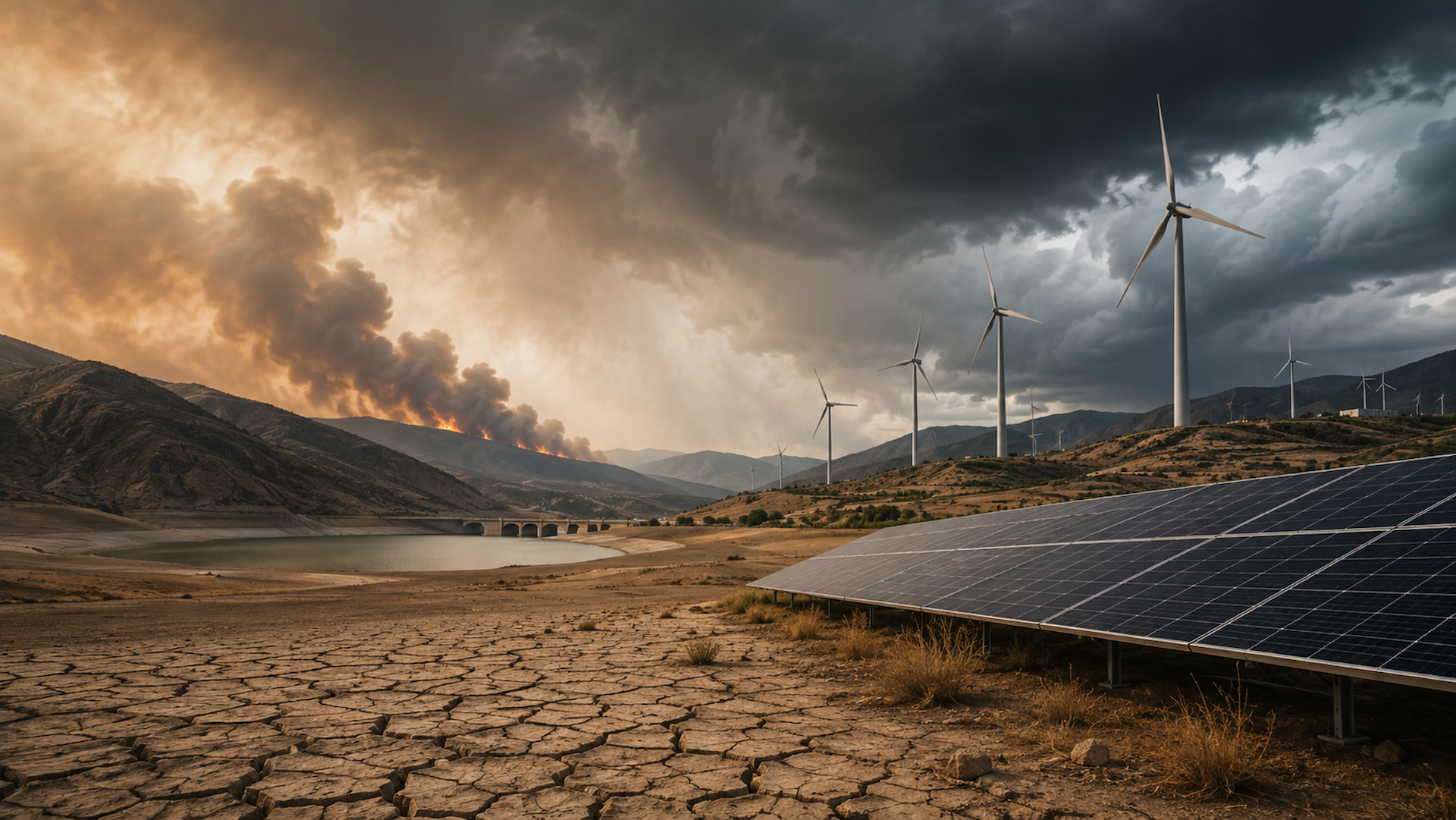
Europe has spent years preparing for a warmer future. Now that future is arriving faster than expected, and it is exposing an uncomfortable contradiction at the heart of the continent’s energy transition.
Relentless heat, depleted rivers, drought-stricken farmland and recurring wildfires are providing precisely the evidence climate scientists have long warned about. Yet instead of producing a straightforward acceleration toward renewable energy, these conditions are forcing European governments to confront a more difficult question: how quickly can an energy system be transformed when the consequences of climate change are already disrupting the infrastructure on which that transformation depends?
The answer emerging across the continent is increasingly pragmatic. Europe is not abandoning decarbonization. But the route toward it is becoming less ideological, more politically defensive and considerably more complicated.
When Climate Ambition Meets Climate Reality
At first glance, record temperatures should strengthen the case for moving faster on renewable energy. In practice, the political effect has been more ambiguous.
European governments remain committed to replacing fossil fuels with lower-carbon sources including wind, solar and nuclear power. What is changing is the willingness to treat the transition as a process governed primarily by emissions targets and fixed deadlines.
Economic weakness, higher household energy costs, geopolitical instability and growing electoral pressure have all pushed governments toward a more flexible approach. Extreme weather has added another consideration: Europe must adapt to climate change while simultaneously attempting to limit it.
That distinction matters because even successful emissions reductions cannot immediately reverse the conditions Europe is experiencing today. The continent is warming rapidly, at roughly twice the global average rate, and long-term targets offer little immediate protection against a heat wave occurring this week.
Britain could dramatically expand renewable electricity generation by 2030. The European Union could remain committed to climate neutrality by 2050. Neither objective, however, lowers tomorrow afternoon’s temperature or restores water to a depleted reservoir.
Europe is therefore confronting two climate problems at once. One concerns the emissions of coming decades. The other concerns physical conditions already present.
Heat Becomes an Infrastructure Problem
The latest heat wave, the fifth to strike Europe since May, has again pushed temperatures toward or beyond 37.7 degrees Celsius in parts of Britain and continental Europe.
The consequences extend far beyond uncomfortable afternoons.
Drought conditions have affected roughly 70 percent of England, while drought alerts have spread across large parts of the European Union. Low rainfall is placing additional pressure on drinking-water reserves, agriculture, electricity production and firefighting capacity. Dry vegetation has increased wildfire risks, while governments have been forced to reconsider working hours, school schedules and energy consumption during periods of exceptional heat.
Emergency planning has consequently moved climate adaptation from environmental ministries into the machinery normally reserved for national crises. In Britain, Prime Minister Andy Burnham convened the government’s COBRA emergency committee to coordinate the response to extreme temperatures.
Elsewhere, authorities have deployed aircraft against wildfires, imposed restrictions on water use, introduced measures to reduce electricity demand and adjusted public services around dangerous temperatures.
Such measures reveal something that emissions targets alone cannot solve. A warmer Europe requires more resilient infrastructure, and building that resilience can itself increase energy demand.
Air conditioning is the most obvious example.
Historically uncommon in many European homes, cooling systems are becoming increasingly attractive as temperatures rise. Yet widespread air-conditioning adoption would add significant electricity demand precisely when grids are already being reconfigured around new generation technologies.
That tension is rapidly becoming political.
The New Electoral Battle Over Climate Policy
Europe’s climate debate is no longer principally a contest between people who accept global warming and those who deny it.
Public acceptance of climate change remains high. More than four-fifths of Europeans regard global warming as a serious problem, and repeated heat waves are unlikely to weaken that conviction.
The sharper political dispute concerns cost, timing and priorities.
Populist parties across Europe have increasingly argued that households should not be asked to absorb expensive climate policies while simultaneously facing higher energy bills, slower economic growth and the immediate costs of adapting to extreme weather.
Their argument is not necessarily that climate change does not exist. It is that governments should prioritize measures voters can feel immediately.
In France, Marine Le Pen’s National Rally has proposed a nationwide expansion of air conditioning ahead of the next presidential election. That position challenges environmental and left-of-center politicians who have traditionally warned that mass adoption of cooling systems could increase electricity consumption and, where fossil generation remains part of the power mix, emissions.
Britain faces a different version of the same argument.
Nigel Farage and Reform UK have called for greater exploitation of remaining North Sea gas resources rather than concentrating political attention on net-zero targets. Conservative leader Kemi Badenoch has also moved sharply against the existing net-zero framework as her party competes for voters attracted to Reform.
These pressures were visible before the latest heat wave. The European Union had already begun reconsidering elements of its environmental agenda, including emissions requirements and the timetable surrounding the transition away from petrol and diesel vehicles.
The objective of decarbonization remains. The political conditions surrounding it have changed.
Affordability Moves to the Center
Energy security has further complicated the calculation.
Rising oil and gas prices initially strengthened arguments for reducing Europe’s dependence on imported fossil fuels. Renewable energy offered not only lower emissions but greater strategic autonomy.
Yet when fossil-energy prices rise, governments must also deal with the immediate consequences for households and industry. That creates pressure to secure supplies today while investing in alternatives for tomorrow.
Britain illustrates the dilemma particularly clearly.
Burnham has indicated that his government could approve two North Sea drilling licenses issued under the previous Conservative administration, describing his position as pragmatic. His energy secretary has meanwhile emphasized affordability, arguing that maintaining public support for renewable energy requires ensuring that the transition does not become synonymous with unaffordable electricity.
That calculation may prove central to Europe’s next phase of climate policy.
Governments can establish targets through legislation. Maintaining them over decades requires voters to continue accepting the economic and practical consequences.
The emerging strategy is therefore less about retreating from decarbonization than preventing the transition from losing democratic legitimacy.
When Drought Reaches the Power Station
No country illustrates the complexity more starkly than Hungary.
Roughly half of Hungary’s electricity is generated by nuclear power. Because reactors produce electricity without the direct carbon emissions associated with coal or gas generation, nuclear energy has increasingly been incorporated into Europe’s broader decarbonization strategy alongside renewables.
Then extreme weather exposed a vulnerability that carbon accounting does not capture.
Hungary’s Paks nuclear power station was forced to shut down this month. The cause was not a reactor malfunction, damaged equipment or fuel shortage.
It was water.
Thermal power stations require reliable cooling, and Paks has historically depended on the Danube River. Persistent drought and exceptionally high temperatures pushed river conditions to critical levels, undermining a resource that had long been treated as dependable.
The episode encapsulates Europe’s emerging energy dilemma.
A low-carbon electricity source designed to help limit future warming became vulnerable to the physical consequences of warming already underway. The problem was not whether nuclear power qualifies as green, nor whether wind and solar should replace fossil fuels faster. It was whether the surrounding environment could still provide the conditions under which existing infrastructure was designed to operate.
That question reaches far beyond Hungary.
Hydroelectric generation depends on water levels. Nuclear and conventional thermal stations require cooling. Solar panels can lose efficiency under extreme heat. Electricity networks face heavier demand during prolonged periods of high temperatures. Wildfires threaten transmission infrastructure. Drought can disrupt waterways used to transport fuels and industrial materials.
Climate change is therefore no longer merely one of the reasons Europe is redesigning its energy system. It is becoming one of the forces determining which technologies remain reliable, where they can operate and what supporting infrastructure they require.
Europe’s green transition is not disappearing. It is entering a more difficult stage, one in which emissions, affordability, energy security, water availability, grid resilience and electoral politics can no longer be considered separately.
The summer’s extreme weather has made the contradiction unusually visible. Europe still needs to build an energy system capable of reducing the climatic risks of the future. Increasingly, however, it must build that system inside the unstable climate of the present.