
Airborne Humidity Becomes a Power Source in New Biodegradable Electronics Breakthrough
Humidity has long been treated as the silent enemy of electronics. Moisture corrodes circuits, destabilizes components, and shortens device lifespans. Now, a team of researchers from Queen Mary University of London, University of Warwick, Imperial College London, and Universitas Mercatorum has turned that assumption upside down by creating a biodegradable generator that converts moisture in the air into electricity using materials more commonly found in kitchens than laboratories.
Humidity has long been treated as the silent enemy of electronics. Moisture corrodes circuits, destabilizes components, and shortens device lifespans. Now, a team of researchers from Queen Mary University of London, University of Warwick, Imperial College London, and Universitas Mercatorum has turned that assumption upside down by creating a biodegradable generator that converts moisture in the air into electricity using materials more commonly found in kitchens than laboratories.
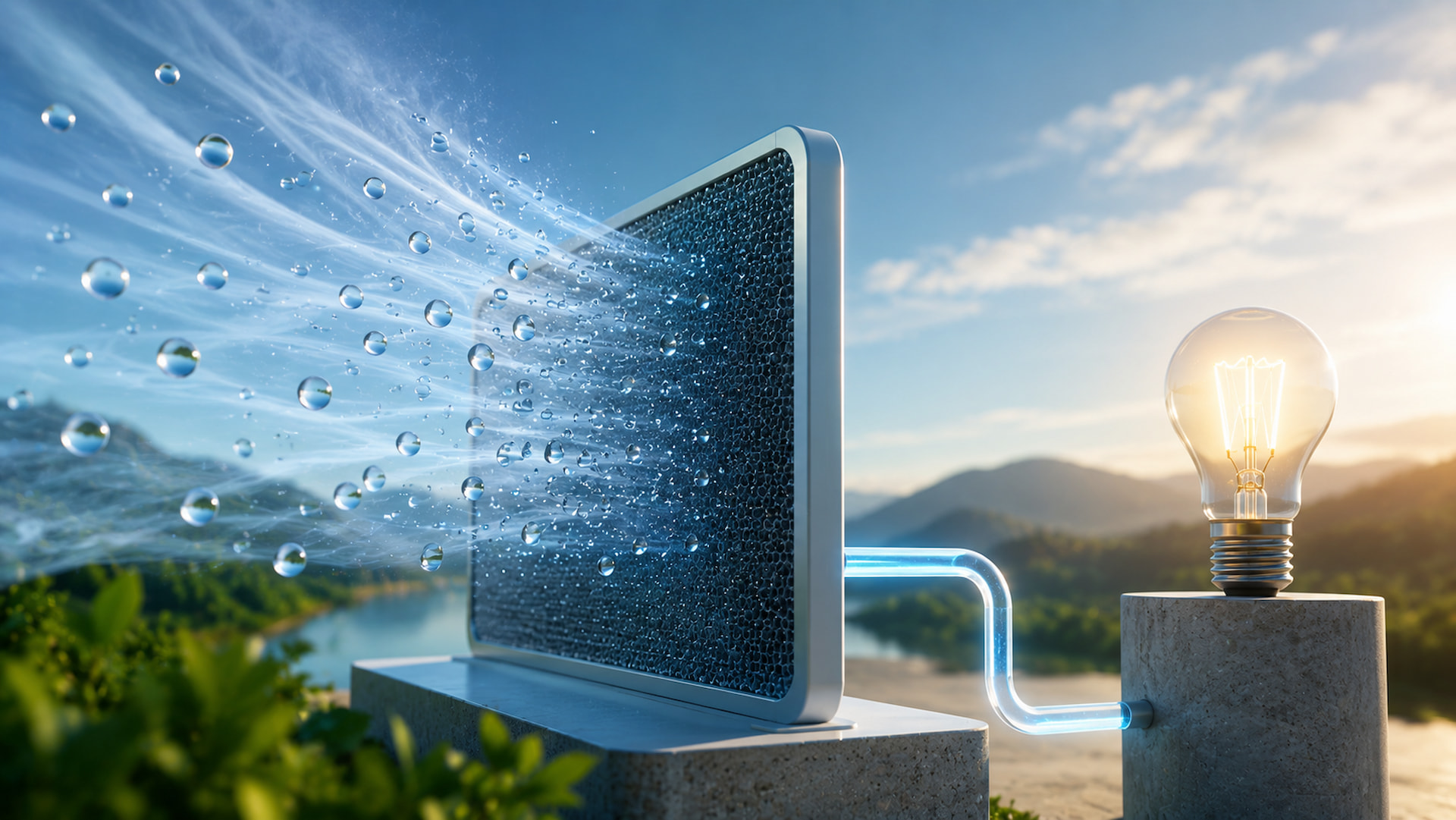
Detailed in the journal Nano Energy, the newly developed Moisture-Electric Generator, or MEG, relies on gelatin, table salt, and activated carbon to produce electrical energy from ambient humidity. Instead of shielding electronics from water vapor, the system uses atmospheric moisture as the mechanism that drives power generation.
The concept introduces a markedly different philosophy in energy device engineering. Rather than depending on lithium, rare metals, or chemically intensive manufacturing, the generator is assembled through a water-based fabrication process using inexpensive and widely accessible ingredients. The result is a soft, environmentally compatible material capable of generating stable electricity without toxic components or conventional battery chemistry.
Its operation begins when the gelatin-salt matrix absorbs moisture either from the surrounding environment or directly from human skin. During drying, the material spontaneously forms a layered internal structure. Exposure to humidity then activates ion transport across these layers, producing a continuous electrical output of roughly one volt per device for more than a month.
To demonstrate scalability, the researchers linked multiple units together, ultimately reaching outputs of 90 volts and 5.08 milliamperes. The assembled system successfully powered small electronics, including a 40-bulb LED array, showing that the technology can move beyond laboratory-scale proof of concept.
Dr. Ming Dong, first author of the study and Postdoctoral Research Associate at Queen Mary’s School of Engineering and Materials Science, explained that high-voltage generation is often associated with expensive materials and technically demanding production methods. According to Dong, the study demonstrates that simple combinations of biodegradable compounds can achieve meaningful electrical performance when designed around naturally occurring humidity.
The material also operates as a highly responsive moisture sensor. Because its electrical behavior changes with subtle fluctuations in humidity, the device can register physiological activity linked to exhaled water vapor. Researchers demonstrated real-time breathing detection and observed measurable electrical variations produced during speech.
That sensitivity opens potential applications in wearable diagnostics, touch-free interfaces, and battery-independent sensing systems. The technology may eventually support lightweight health-monitoring devices capable of operating continuously without traditional charging infrastructure.
Equally significant is the generator’s end-of-life profile. Conventional electronic waste remains one of the fastest-growing environmental burdens worldwide, largely because many devices contain plastics, solvents, and heavy metals that resist safe disposal. The MEG was specifically designed to avoid that problem.
Once discarded, the material can naturally decompose in soil within weeks. It can also be dissolved in water, allowing components to be recovered and reused without hazardous processing. This positions the technology within the growing field of circular electronics, where devices are designed not only for performance, but also for environmentally safe recovery and reintegration.
Dr. Dimitrios Papageorgiou, Reader in Functional Polymers and Composites at Queen Mary and corresponding author of the research, said the project was intended to challenge assumptions surrounding how electronic materials are produced. He noted that the performance achieved with a gelatin-based architecture suggests substantial room for future development and large-scale adaptation.
The study arrives at a moment when researchers worldwide are searching for alternatives to resource-intensive batteries and disposable electronics. By extracting usable electricity from ordinary humidity through biodegradable materials, the work points toward a class of electronic systems that may eventually operate with far lower environmental cost than today’s dominant technologies.