
Europe’s Autonomous Vehicle Dilemma: Innovation Built at Home, Momentum Found Abroad
Across airport corridors in Tallinn, a compact autonomous shuttle moves quietly between hangars, reading intersections, identifying nearby vehicles, tracking pedestrians, and recalculating its route in real time. The technology behind it is European from end to end. The strongest demand for it, however, is not coming from Europe.
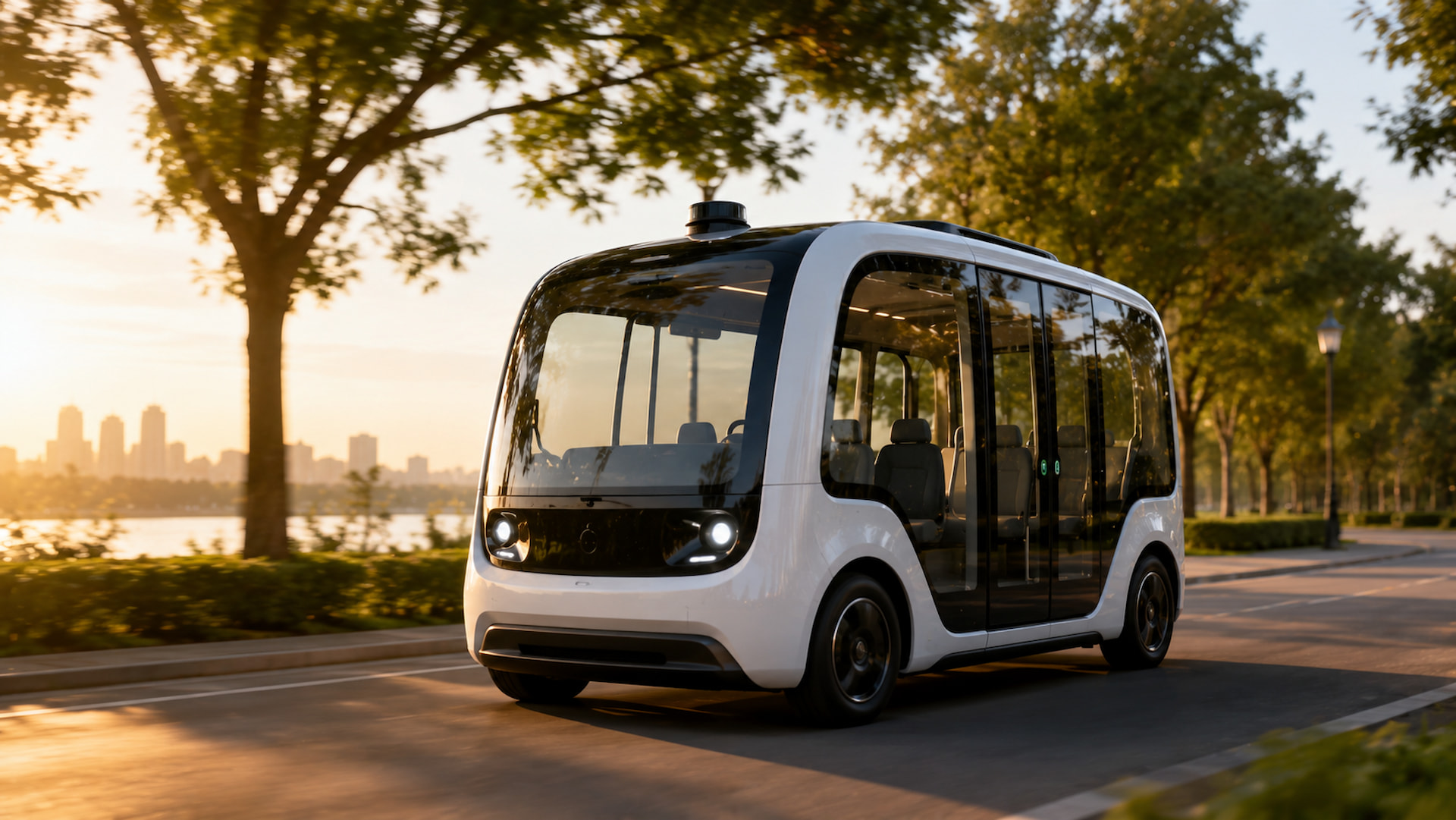
Across airport corridors in Tallinn, a compact autonomous shuttle moves quietly between hangars, reading intersections, identifying nearby vehicles, tracking pedestrians, and recalculating its route in real time. The technology behind it is European from end to end. The strongest demand for it, however, is not coming from Europe.
Developed in Estonia by AuVe Tech, the MiCa autonomous shuttle has become an unusual symbol of Europe’s position in the global race for self-driving transport. The vehicle, designed and manufactured entirely within the European Union, is already operating internationally while struggling to gain comparable momentum inside its own market.
The electric shuttle accommodates eight passengers, can function autonomously for up to twenty hours a day, and reaches speeds of 25 kilometres per hour. Beneath its compact exterior sits a dense stack of technology that includes LiDAR systems, cameras, environmental sensors, and AI-driven navigation software capable of reacting dynamically to changing surroundings.
According to company engineers, the vehicle continuously interprets its environment by identifying roads, intersections, moving objects, pedestrian crossings, and nearby traffic. Using that information, the system calculates the safest and most efficient path toward its next destination without human intervention.
The project recently reached another milestone when autonomous driving trials were authorised at Tallinn Airport. During the tests, prototype vehicles transported passengers and travelled more than two thousand kilometres around restricted airport infrastructure. Developers believe the technology could eventually provide continuous transport for maintenance personnel while lowering operational costs and reducing emissions.
Founded in 2018 in cooperation with Tallinn University of Technology, the company has already deployed vehicles in seventeen countries, including markets across Europe, the United States, Israel, Saudi Arabia, the United Arab Emirates, and Japan. Yet executives acknowledge that the most ambitious deployments are increasingly concentrated outside the European Union.
Japan has emerged as one of the clearest examples. Government-backed programmes there have established defined rollout targets for autonomous transport systems, encouraging municipalities to integrate self-driving shuttles into public transit networks. In some regions, autonomous buses already serve as primary transportation infrastructure.
Executives at AuVe Tech argue that Europe lacks both the political urgency and financial commitment required to compete at the same pace. While China and the United States continue directing large-scale investments into autonomous mobility, European support remains fragmented and cautious.
Company representatives point not only to limited funding, but also to regulatory complexity. Although the European Union operates under a shared political framework, autonomous vehicle developers still face separate approval systems, certification procedures, and operational requirements across all twenty-seven member states.
That fragmentation, executives argue, drains resources away from engineering and product development. Instead of concentrating investments on refining software, improving safety systems, and scaling production, companies are forced to navigate overlapping national regulations before vehicles can even reach public roads.
The concern extends beyond one manufacturer. Industry advocates increasingly warn that Europe risks losing industrial leadership in a sector expected to shape the future of urban transport, logistics, and public mobility.
The irony is difficult to ignore. The MiCa shuttle is assembled entirely in Estonia, one of Europe’s most digitally advanced economies. Production remains local, allowing tighter manufacturing oversight and faster quality control. According to company managers, a single shuttle can be completed within a week.
At the same time, demographic pressure is strengthening the argument for automation. European transport systems are already confronting growing labour shortages, particularly among professional drivers. Autonomous shuttle systems are increasingly presented not as futuristic experiments, but as practical responses to an approaching workforce gap.
Developers also argue that autonomous systems are beginning to demonstrate safety records that compare favourably with human-operated transport. Markets such as Japan, the Gulf states, and parts of the United States have shown greater willingness to integrate that reality into long-term infrastructure planning.
Within European institutions, concern about falling behind appears to be intensifying. Discussions in the European Parliament have recently framed 2026 as a decisive period for Europe’s autonomous mobility ambitions. Industry platforms supported by EU funding have warned that delays could widen the technological gap with China and the United States to the point where catching up becomes increasingly difficult.
For companies building autonomous systems inside Europe, the debate is no longer only about transport technology. It has become a broader question about industrial sovereignty, manufacturing competitiveness, and whether Europe intends to remain a producer of next-generation mobility systems or merely a customer purchasing them from elsewhere.