

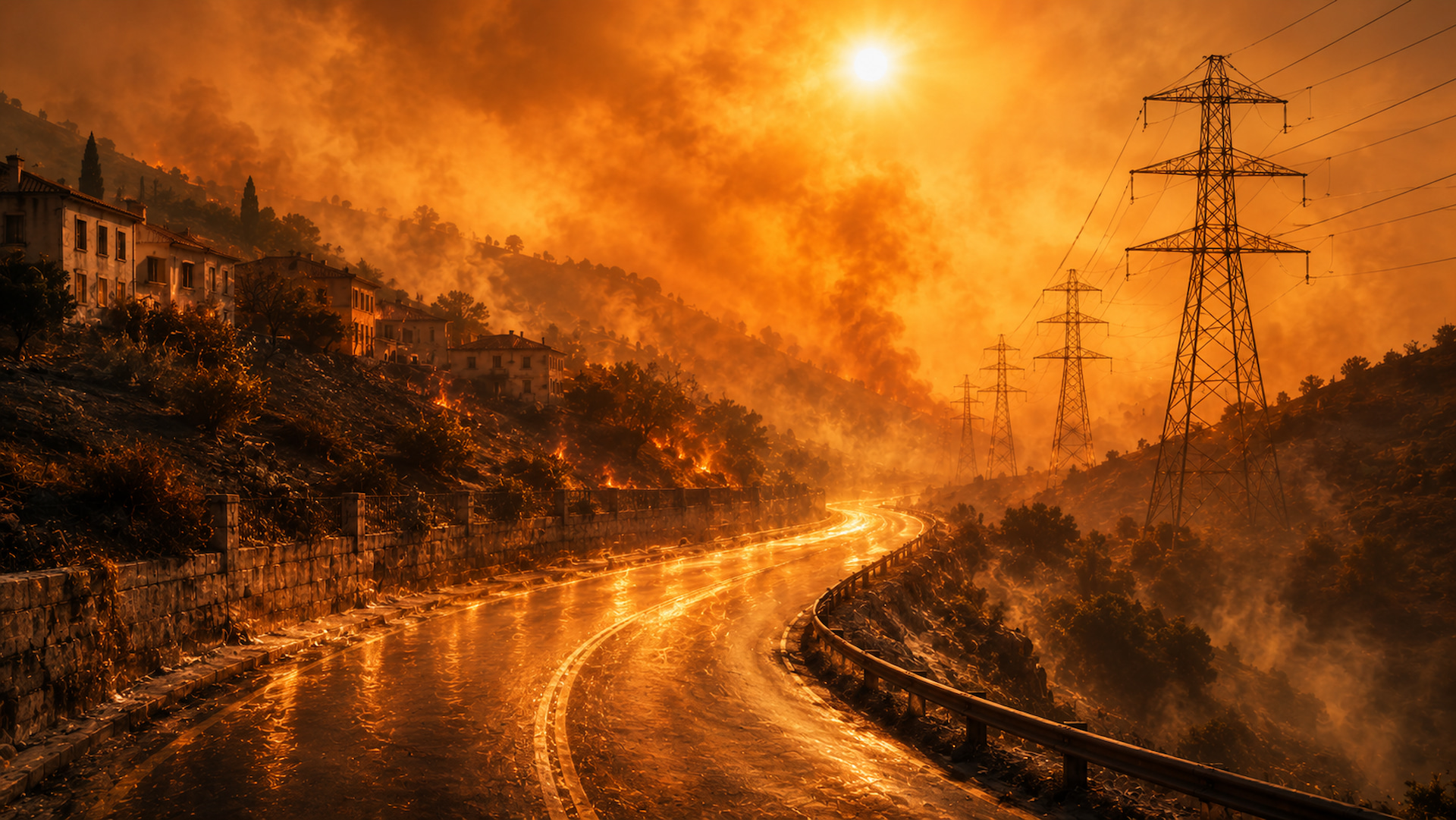
At least eleven people died on a Friday in Los Gallardos, in southern Spain, near Almeria. Four appeared to be British, the regional health minister said, because they were found in a vehicle with the steering wheel on the right side. The regional president said the majority of those killed were foreigners. They had come to a part of Europe that has welcomed visitors for generations because of its warmth, its light, and its long promise of summer.
Some of the victims, officials said, had chosen a different route from the evacuation path recommended by authorities. They walked into a dry riverbed. In another season, perhaps in another decade, that word might have suggested safety: a depression in the land, a path cleared by water, a place low enough to follow. On that afternoon, it became a trap. The fire moved faster than the people.
The blaze consumed almost 7,800 acres and reached a highway. Hundreds of emergency responders were sent to contain it. The Spanish royal family cancelled a ceremonial toast and asked for silence for the dead.
The wider map was burning at the same time. In the Pyrénées-Orientales, near Perpignan, the area of a wildfire almost tripled within a single day. More than 10,000 people were evacuated from 26 communes. Firefighters arrived from abroad, including Sweden and Cyprus. The Tour de France had to keep spectators away from one stage. In France, Météo-France placed numerous départements under orange warning, with Bordeaux and Toulouse expecting up to 44 degrees and local temperatures near the Pyrenees possibly reaching 46. Paris may cross 40. Spain declared its highest alert level across Aragon, Catalonia, and Valencia. Portugal is burning. Greece is burning. Italy has heat warnings in cities including Florence. The World Health Organization has warned of the danger.
This is not an exceptional summer. This is the direction of travel.
What the Climate Is Already Doing
The facts are no longer confined to projections. The June 2026 heatwave is described by researchers as the most severe recorded across large parts of Western Europe. A comparable June heatwave would have been approximately 3.5 degrees cooler in 1976. Nighttime temperatures, the kind that keep the body from recovering and turn vulnerable homes into dangerous spaces, would have been more than a hundred times less likely in 2003 than they are today. Across large parts of Western Europe, June is warming faster than any other month. The hottest daily temperatures are rising at roughly triple the rate of global warming.
These are measurements of a changed climate, not warnings about a distant one.
The buildings were not designed for this. Many apartments in southern and western Europe were built for retaining warmth, not rejecting it. Evacuation routes were planned for fires moving through known landscapes, not for fires that expand across thousands of acres under extreme heat and dry wind. Dry riverbeds were not always dry. Forests that once held more moisture now carry different risk. The landscape has changed faster than the maps, the habits, and the instincts people use to move through it.
That is what the dry riverbed in Los Gallardos reveals. It was not only a place. It was a failure of interpretation. People looked at the land and made a decision. The land no longer behaved as they expected.
The Energy Connection That Is Not Being Made
At the same time, Europe is having another conversation in policy briefings and energy economics reports. It is about fossil fuel imports, gas price volatility, renewable electricity, storage, grids, and efficiency. That conversation matters. The European Environment Agency has reported that renewables saved Europe €29 billion in the first part of this year, while gas price spikes cost an additional €13 billion. Those are serious numbers. They show that renewable electricity is already protecting households, businesses, and governments from part of the economic violence of fossil volatility.
But the people in the dry riverbed were not killed by electricity prices. The fire was not driven by a bad tariff structure. The heatwave was not a market event. It was a physical event created by accumulated emissions over time.
The carbon now shaping European summers did not arrive this year. It accumulated over more than a century of energy choices that were often rational within their own economic logic and disastrous in their physical consequence. Coal kept factories running. Oil moved ships, trucks, aircraft, and tourists. Gas heated homes and balanced grids. Each decision made sense inside the system that rewarded it. Together, they altered the atmosphere in which every future decision must now be made.
The energy system that produced this summer will not disappear quickly. It is too large, too embedded, too politically defended, and too useful in too many daily ways. The question now is whether the next energy architecture carries the same structural dependencies, or whether it represents a different relationship between power and the physical world.
Renewables are necessary. So are grids, storage, demand response, efficiency, and electrification. But necessary is not the same as sufficient. A system that still depends on long infrastructure chains, weather patterns, storage capacity, import exposure, and slow permitting remains vulnerable to the same mismatch now defining Europe’s summers: physical change moving faster than institutional change.
What a Different Architecture Looks Like
This is where the Neutrino® Energy Group belongs in the discussion, not as a saviour, and not as a claim that any technology could have prevented the deaths in Los Gallardos or the fires now burning across southern Europe. The connection is structural.
Holger Thorsten Schubart, a visionary mathematician and the Architect of the Invisible, founded the Neutrino® Energy Group as a global innovation ecosystem developing neutrinovoltaic technology. The framework is based on multi-channel ambient energy conversion through graphene-silicon nanostructures operating as open non-equilibrium systems. It does not depend on combustion. It does not require fuel logistics. It does not treat neutrinos as the only input channel. It treats the physical environment as a continuous field of usable inputs, including thermal gradients, electromagnetic background fields, cosmic particle interactions, and other ambient micro-excitations.
The governing framework is the Schubart Master Formula: P(t) = η · ∫V Φ_eff(r,t) · σ_eff(E) dV
The formula describes continuous electrical output from ambient flux integrated across an active material volume. Φ_eff represents the effective multi-channel environmental input. σ_eff(E) describes the effective coupling between that input and the material architecture. η represents bounded conversion efficiency. The volume integral matters because the architecture is designed around penetrating flux and layered material response, not only surface collection.
Internal Monte Carlo simulations and multi-parameter evaluations indicate statistical consistency reaching 5.9 to 6.0 sigma, above the five-sigma threshold conventional in modern physics. This quantifies model consistency under applied assumptions, not commercial performance at industrial scale.
That distinction is essential. Neutrinovoltaic technology is not yet deployed at the scale that would change the climate trajectory of a European summer. It does not cool burning forests by assertion. Its relevance is different: it points toward an energy architecture that does not burn anything, does not import fuel, and does not make power generation depend on the same combustion logic that produced the risk now visible in the landscape.
What People in These Fires Need
The eleven people who died in Los Gallardos needed accurate, immediate information about where the fire was moving. They needed evacuation routes that remained safe under extreme conditions. They needed emergency services with enough reach, speed, and communication capacity to guide people out before the landscape closed around them. They also needed something more ordinary, which is often what climate adaptation really means: places to stay cool, water that remains available, and infrastructure that continues functioning when the grid is under stress or when fire reaches a road.
The dry riverbed matters here because it shows how quickly survivability becomes local. A decision made on foot, under smoke and heat, can determine life or death. But that decision is shaped by systems built long before the fire arrives: warning systems, mobile networks, power availability, cooling access, water supply, medical readiness, and the resilience of homes.
The Neutrino Life Cube, combining target continuous output in the 1 to 1.5 kilowatt range with integrated climate control and air-to-water purification producing 12 to 25 litres of clean drinking water per day depending on climatic conditions, is not a wildfire solution. It is a response to the conditions that make wildfire seasons more or less survivable: power for cooling when demand peaks, water when supply is compromised, autonomous operation when the grid fails, and basic resilience when central infrastructure cannot reach every place at once.
That is not sentiment. It is the point at which energy architecture becomes humanitarian infrastructure.
The Question Left by the Fire
Every summer for the past decade has been described as exceptional. The word is losing its meaning. The exceptional is becoming the baseline, and researchers are no longer merely projecting the change. They are measuring it.
The energy architecture responsible for this trajectory is being reformed through renewable deployment, grid investment, efficiency improvements, and electrification. That reform is necessary and insufficient at the same time. It is necessary because every tonne of avoided emissions matters. It is insufficient because the atmosphere responds to physical accumulation, not to policy intention, and the timeline of heat does not wait for the timeline of infrastructure.
The dry riverbed in Los Gallardos was once a safer image than it is now. The forest above Perpignan was once a different kind of forest. The question is not whether the world is changing. It is whether the systems that caused the change are being replaced fast enough to matter.


